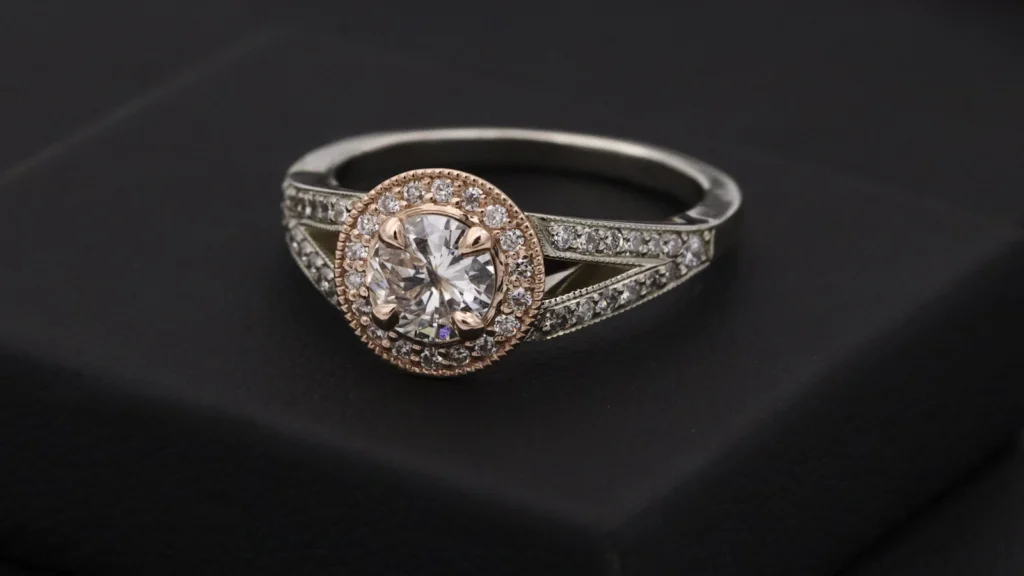
How big is a 1 carat diamond? A round brilliant diamond of one carat measures about 6.3 to 6.5 millimetres across the top, which is roughly a quarter of an inch. That sounds modest on paper, yet a well-cut stone of that size is large enough to draw attention on a finger and is one of the most popular choices for an engagement ring.
The answer changes with shape, cut quality and even the setting around the stone, so a single number only tells part of the story. This guide gives you the millimetre sizes for round and fancy shapes, explains why two diamonds of the same weight can look different, and shows how to choose a stone that looks as large as your budget allows.
How Big Is a 1 Carat Diamond?
For a round brilliant diamond, one carat usually means a diameter of around 6.3 to 6.5 mm. Jewellers quote slightly different averages, but the spread is small. A well-proportioned stone sits at the larger end of that range, while a deep, poorly cut stone sits at the smaller end.
Carat is a weight, not a size
A carat is a unit of weight. One metric carat equals 0.2 grams, which is about the weight of a small paper clip. The size you see from above depends on how that weight is spread through the stone. If more of the weight is hidden in a deep base, the diamond looks smaller from the top. If the weight is spread out in a shallower shape, it looks wider.
This is why jewellers describe size in millimetres as well as carats. Millimetres tell you how large the stone will actually appear on the finger, while carats tell you what it weighs and, to a large extent, what it costs.
1 Carat Diamond Size Chart for Round Diamonds
The table below shows typical diameters for round brilliant diamonds at common weights. Use it to see where a one-carat stone sits compared with smaller and larger sizes.
| Carat weight | Typical diameter |
|---|---|
| 0.25 carat | About 4.0 mm |
| 0.50 carat | About 5.0 mm |
| 1.00 carat | About 6.3 to 6.5 mm |
| 1.25 carat | About 6.9 to 7.0 mm |
| 1.50 carat | About 7.3 mm |
| 2.00 carat | About 8.0 mm |
| 3.00 carat | About 9.3 mm |
Notice how the diameter grows slowly while the weight doubles. Going from one carat to two carats adds only about 1.5 mm to the width, yet the price rises much faster than the size. That gap is one of the biggest things to understand before you set a budget.
1 Carat Diamond Size by Shape
Round diamonds are the standard reference, but other shapes carry their weight differently. Some look bigger than a round stone of the same carat weight, and some look smaller.
| Shape | Typical 1 carat size |
|---|---|
| Round brilliant | About 6.3 to 6.5 mm across |
| Princess | About 5.5 mm per side |
| Oval | About 7.7 x 5.7 mm |
| Marquise | About 10 x 5 mm |
Why elongated shapes look larger
Ovals and marquise stones are long and narrow, so they stretch across more of the finger and look bigger than a round diamond of the same weight. A one-carat marquise can appear noticeably larger, even though it weighs exactly the same.
Why square shapes can surprise you
A princess cut measures about 5.5 mm per side at one carat, which sounds smaller than a round stone. The measurement is taken along one edge, though, and the square shape covers more surface area out to the corners. In practice, a princess cut often looks about as large as a round diamond of similar weight.
Why Cut Quality Changes the Size You See
Two diamonds can both weigh one carat and still differ in width. A deep cut pushes weight into the lower part of the stone and shrinks the face-up diameter, while a shallow cut spreads the weight out and makes the stone look wider.
The range is real. A one-carat round diamond can measure as little as about 5.6 mm if it is cut very deep and as much as about 6.6 mm if it is cut shallow. A deep stone at the small end can look like a smaller diamond than its weight suggests, while a well-cut stone looks fuller and brighter.
The effect can even reverse the usual rule that heavier means bigger. A poorly cut 1.25 carat diamond can appear about the same size as a well-cut 1 carat stone. That is why it pays to compare the measurements on a grading report, not just the carat weight. The other quality factors, including colour and clarity, are covered in this guide to diamond quality factors, which is a useful companion when you compare stones.
How a 1 Carat Diamond Looks on a Finger
Size on paper and size on a hand are not the same. A 6.4 mm stone looks different on a slim finger than on a wider one, and the setting around it changes the impression even more.
- A thin band makes the diamond look larger because there is less metal to compete with it.
- A halo of small stones adds visual width around the centre diamond.
- A raised setting shows more of the stone from the side, while a low setting hides some of it.
- A slimmer finger makes any stone look bigger by contrast.
If you are shopping for a ring, try on settings with a similar stone size before you decide. A photo of a ring on someone else’s hand is a poor guide, because finger width and camera angle both distort how large the diamond seems.
Is a 1 Carat Diamond a Good Size?
For many buyers, one carat is the sweet spot. It is large enough to look generous without being a huge expense, and it is easy to find in many shapes and quality levels. It is also a milestone weight, which means it carries a premium in the market.
Price rises faster than size as you climb the carat scale because large diamonds are rarer. As an illustration, a one-carat stone might be worth around $6,000, while a two-carat stone of similar quality could be worth around $15,000. Prices vary widely with quality, so treat those figures as an example, not a quote.
The premium for hitting exactly one carat is also worth knowing. A stone that weighs 0.98 carat and one that weighs 1.01 carats look almost identical, yet the larger one can cost noticeably more. Choosing a stone just under the milestone, such as 0.95 carat, can save money for a diamond that looks nearly the same.
How to Get the Most From a 1 Carat Budget
- Prioritise cut quality, because it controls sparkle and affects how large the stone looks.
- Compare the millimetre measurements on the report, not only the carat weight.
- Consider a stone just under one carat if you want to save money without a visible loss in size.
- Think about an elongated shape such as an oval if you want the stone to look larger.
- Choose a slim band or a halo to make the centre diamond appear wider.
- Try rings on in person where possible, so you see the real scale on a finger.
If you are comparing jewellery styles as well as sizes, our guide to what a black wedding ring means shows how different band styles change the overall look. And if you are balancing a large purchase against other costs, our breakdown of how much a Highland cow costs is a good example of planning for buying and running costs together.
Frequently asked questions
How many mm is a 1 carat diamond?
A round brilliant diamond of one carat measures about 6.3 to 6.5 mm across. The exact figure depends on cut quality, and a very deep or very shallow cut can push it a little below or above that range.
How much does a 1 carat diamond weigh?
One carat equals 0.2 grams, which is about the weight of a small paper clip. Carat is a measure of weight, so the visible size of the stone depends on shape and cut as well as weight.
Is a 1 carat diamond big?
It is a mid-sized, popular diamond. A well-cut round stone is about a quarter of an inch across and looks generous on most hands, especially in a slim band. Larger stones are noticeably bigger, but they cost far more.
Does the shape change how big a diamond looks?
Yes. Elongated shapes such as ovals and marquise stones look larger than a round diamond of the same weight because they cover more of the finger. A princess cut measures smaller along one edge but still looks substantial.
Does cut quality affect the size of a 1 carat diamond?
Yes. A deep cut hides weight in the base and makes the top look smaller, with a diameter near 5.6 mm. A shallow cut spreads the weight and can reach about 6.6 mm, although a very shallow cut can look dull.
Is a lab-grown 1 carat diamond the same size?
Yes. A lab-grown diamond has the same chemical makeup as a natural one, so a lab-grown stone of the same weight, cut and shape has the same dimensions. Check the measurements on the report to be sure.
Conclusion
How big is a 1 carat diamond? About 6.3 to 6.5 mm for a well-cut round stone, with other shapes and cuts shifting that figure up or down. Compare millimetre measurements rather than weight alone, prioritise cut quality and consider a stone just under one carat. Those choices help you buy a diamond that looks larger than its price suggests.

Tasha Harshman is a versatile writer who explores a range of topics with a special focus on entertainment. She enjoys sharing clear, engaging insights about movies, celebrities, trends, and pop culture.